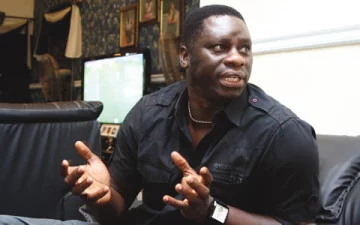
My wife helped me walk again – Former Super Eagles goalkeeper, Joseph Dosu
By
DailyPost Staff on March 31, 2013
 In
an interview with the Punch Newspaper’s ‘Tana Aiyejana, former Super
Eagles goalkeeper spoke on the car crash that ended his short football
career, how his wife helped him through that phase and many other
memories.
Excerpts:
How is life in retirement?
In
an interview with the Punch Newspaper’s ‘Tana Aiyejana, former Super
Eagles goalkeeper spoke on the car crash that ended his short football
career, how his wife helped him through that phase and many other
memories.
Excerpts:
How is life in retirement?
I will say life’s been good but then life after retirement for a
footballer is not an easy thing. As a footballer, you are used to
training in the morning, afternoon and evening but after retirement, you
have to sit most times now whether at home or in the office.
Do you find your new role as a football pundit on TV challenging?
It’s brought me back into the football circle again. Though it’s
something new to me but I am enjoying every bit of it, thanks to Niyi
(Oyeleke) who helped me. I’m still into football, managing the young
ones and trying to carve a career path for them but analysing is equally
an interesting part of football.
Can you tell me about your family?
My mother is Togolese while my dad is Nigerian from Badagry; that was
why there was a lot of controversy about my nationality. But I am a
Lagosian, a Nigerian. My mother was a beans seller and it’s what she did
after giving birth to six of us; four boys and two girls. She sold
beans, yam and plantain as well. We enjoyed it while growing up, we
never went hungry and the food was very delicious. She did that to train
all of us and we never regretted it. It was a sweet life and we had fun
all through till we became what we are today.
With such humble beginning, did you think you could make it in life?
Life is all about dedication, discipline and determination towards
what you want to become. I was very good in football, goalkeeping
especially, so I decided not to hide my talent. Most people don’t know
this but I am not the first person that played football in my family. My
elder brother, David Dosu, was an excellent goalkeeper too and he kept
up to YSFON and Flying Eagles levels. He played for Racca Rovers of Kano
and played alongside Alloy Agu and the Olukanmi brothers in YSFON. My
other brother, Abass also played football but he left the game to
continue with his education. In my family, everyone is a goalkeeper, so
it encouraged me to also become a keeper as a well. My younger brother,
John, now with Warri Wolves is also a keeper and has played for big
clubs like Shooting Stars, Nassarawa United and Akwa United.
When did the breakthrough come?
It wasn’t easy because my mother was against me becoming a sportsman
or footballer because my elder brother was one already. All she wanted
was for me to go to school. But my brother defended me. My father is a
quiet person. He just laughed over it and gave us his blessings but
advised us to listen to our mum. I started with a team in my area known
as Olumo Bombers, we played football around the area and the interest
kept growing. Before I knew it, I was snapped up by Nigerlux of Ikeja.
We gained promotion from division two to one in Ikeja League. Igbobi
College saw me when I was keeping for Akoka High School. We played
against St Finbarrs’ and we lost 5-0 but I did very well; it could have
been more. So Igbobi College came calling and from there my career moved
up. I won the Principal’s Cup with Igbobi College and Julius Berger
came for me; Joe Erico was the coach then. I was in the feeders team
with Sunday Oliseh. Erico left and he took me along to Highlanders of
Jos. I performed well and a move to Insurance was on the way but we
didn’t agree terms and Highlanders were not ready to release me. Julius
Berger chairman sent a message to me that I should come back and I was
with them before I travelled out to Europe, Italy precisely. At the end,
my mother was happy that I made it in football and wrote the family’s
name in gold before she died.
How did you seal the deal and how was Europe initially?
Firstly I give thanks to Sunday Oliseh and his elder brother,
Churchill. He made it possible for me to go on trials in Italy. Sunday
was the architect of it, because he spoke to his brother about me. It
wasn’t easy; you are in a country where you don’t know anybody. It’s
you, your God and your talent. They don’t speak English and even those
that understand pretend not to when you talk to them. But the most
important thing for me was to sign a contract and move my family away
from the position we were before. And thank God I signed a four-year
contract with Reggiana.
How did you receive invitation for the Atlanta ’96 U-23 squad?
It was while with Reggiana that I was invited for the 1996 Olympic
Games. Though I have been part of the team, but there were very good
keepers, Abiodun Baruwa and Emmanuel Babayaro was ahead of me. I was
called up as a back-up keeper.
How did you become the number one goalkeeper of the team?
Before we travelled to Tallahassee for camping ahead of the Olympics,
we played a friendly game against Togo and we lost 3-1. Actually, we
didn’t play very well; Nigerians were not happy and they wanted us to
play another game before we travelled. So another match was organised
for us against Shooting Stars. When the team list was released, coach
Bonfrere Jo said, ‘Dosu Joseph will be in goal.’ The then sports
minister, Jim Nwobodo warned me, ‘If you misbehave, you will be dropped
from the team to the Olympics.’ In camping in Tallahassee, we played
our first game against Saudi Arabia and I was on for 45 minutes due to
an injury. Bonfrere came to my room and said, ‘Dosu, I have a keeper who
can play for only 45 minutes, so I have to bring another keeper from
Nigeria.’ He scared me and I told myself I had to go back to training,
no matter how bad my injury was and even if it meant I had to use pain
relievers to kill it. At the Olympics, our first game was against
Hungary and I still didn’t believe I would be given the keeper’s
position. Bonfrere announced the names of 10 outfield players for the
match but he didn’t mention who will keep. Later he said, ‘Dosu Joseph
in goal.’ I didn’t expect it, Nigerians at home didn’t expect it as
well. Everybody was thinking of either Baruwa or Babayaro. Bonfrere gave
me the confidence to believe in myself. We beat Hungary 1-0, beat Japan
2-0 but we lost our last group match to Brazil but that game brought me
to limelight. I did very well and from there, we didn’t look back until
we became the first African team to win a football gold at the
Olympics.
Can you recall the semi-final match versus Brazil?
The first game we played against them in the group stage gave us a
lot of confidence that we could beat them. Though they won 1-0, they
were not better than us. We were down 3-1 before the break in the
semi-final. As we were going down the tunnel during half time, Bonfrere
said if we don’t concede the fourth goal, we will win the game. And we
were looking at ourselves and thinking, can this happen against almighty
Brazil? So the coach removed a defender and brought in Wilson Oruma.
And we played three defenders with a lot of midfielders and attackers.
Before we knew it, Austin Okocha should have made it 3-2 but he lost a
penalty. Not long after, Victor Ikpeba scored our second and Nwankwo
Kanu, I call him the King, grabbed our equaliser. In extra time, we
thought the game would extend to extra time but Kanu emerged again to
give us the winning goal. It was sudden death, meaning whoever scored
first in extra time will win the game but we didn’t know because it was a
new rule then. We thought the game would continue until the referee
sounded his final whistle and we went into wild jubilations.
How were you able to beat Argentina in the final?
After beating Brazil, we were sure of beating the Argentines but they
stunned us with a first minute goal but Celestine Babayaro equalised
for us and from that point, there was no going back. They went ahead in
the second half through a penalty but we equalised again and Emmanuel
Amuneke, whose two goals helped Nigeria win the Africa Cup of Nations in
1994, got the winner and suddenly we were Olympic champions.
You were gradually becoming one of Nigeria’s top keepers when
you had an accident that ended your career in 1997 after the Eagles
qualified for the ’98 World Cup. What happened?
My career was short-lived because of the accident. It happened after
we beat Guinea 3-0 to qualify for the 1998 World Cup in France. After
the game, we went back to Sheraton, our hotel and I prepared to visit my
wife and children. I was with a friend, Saturday, a policeman on my way
home when I had the accident. It was along the Lagos-Ikorodu Road.
Suddenly, everywhere went blank; all I could see were cows everywhere.
As I tried to control the car, I veered off the road. I asked the guy
beside me, ‘Saturday are you okay?’ And he said, ‘Yes I’m okay.’ And I
told him, ‘I’m not okay.’ So we were waiting for help and suddenly
Taribo West’s car was passing by though he wasn’t inside. They saw us
and rescued us and took us to Eko Hospital.
Is it true you were drunk while driving?
The first thing the matron did was to smell my mouth to find out if I
was on alcohol. And I replied immediately, ‘I don’t drink and smoke.
It’s just an accident that can happen to anybody. Before I knew it, I
passed out and when I woke up, I found myself in Plaster of Paris.
Did you regret not playing again?
During the early days of my accident, I used to think, ‘I should have
been playing.’ But I had to understand that you can’t play football
forever. I had to stop at a point. Everybody stood by me and made me
understand that football was just by the way. There are so many other
things to live for. Thank God after football, a lot of things have gone
on in my life and I give God the glory.
What role did you wife play in your recovery?
She’s everything to me. When I had the accident, a lot of things were
said: ‘he can’t walk again, he is finished, he will be on wheelchair
for life.’ Maybe if it was another woman, she would have packed out and
left me to my fate. And that would have demoralised me. Maybe I wouldn’t
even walk anymore. But she stood by me during my predicament and
rehabilitation. She was there. She was with me in the hospital when my
operation was done in Tallahassee. She was sleeping on the floor just to
give me the confidence I needed. And I told her not to sleep on the
floor but to sleep in the hotel and come to the hospital every morning.
But she said she preferred to stay by my side rather than waste money.
Did the society accept you back after rehabilitation?
It wasn’t easy because I wasn’t born like this. My first outing after
recovery was in 2000 when Taribo and Friends played against
Professionals at the National Stadium, Lagos. I was amazed at the way
the fans responded when I was taken around the main bowl. They were
waving at me and that showed I was accepted back into the society even
though I wasn’t playing the game anymore. I didn’t give up and had the
belief that I could do better than I did before. I give God the glory
for helping me back.
Sunday Oliseh scored in France ’98 and shouted your name in celebration. Were you filled with emotion?
After recovery, I said I was going to support the team at the World
Cup. So I went to France with Churchill Oliseh, my agent. We were there
before the game against Spain but we didn’t let any of the players know
that we were around. Against Spain, we entered the stadium when
Nigeria’s anthem was played and (Sunday) Oliseh saw us but he wasn’t
sure. So I waved him and he knew we were the one. So when he scored, he
ran towards the corner where we sat and started shouting my name. His
teammates were shocked too and they were asking, ‘Is he here.’ It
reminded me of my time with the team.
Which defender made you most confident while in goal?
Uche Okechukwu, he‘s very confident. A keeper can close his eyes and
he won’t receive a shot because Okechukwu is there. Another defender is
Taribo West. He is very strong. Just tell him to keep a striker out of a
game and he will ensure that the player doesn’t have a shot at goal all
through. These two defenders made the Eagles feared. Any keeper will be
happy to have them play in front of him.
Are your children into sports?
People have said a lot of things about my son, that I didn’t
encourage him to play football. But you can’t force someone against his
wish. He is into taekwondo and rugby but my daughter knows nothing about
sports. She is interested in education.
Where is your Olympic gold medal?
Last week was the last time I saw it after so many years. It is in a
bank. When I saw it, Atlanta memories came back again. I enjoy seeing it
because it makes me happy.
Dosu’s Favourite
1. Colour — My favourite colours are black and white.
2. Car — I don’t really have a favourite but I have an Infinity, CrossFire and Suzuki.
3. Goalkeeper — I watched Dino Zoff, the Italian keeper, while growing. I enjoyed his goalkeeping.
4. Player — The late Muda Lawal is my best. The way he passed the ball and controlled the midfield was amazing.
5. Perfume — I don’t have a favourite but I combine two or three
together, maybe Hugo Boss and Versace, so that people don’t know the
exact perfume I’m using.
6. Designer- I prefer to put on anything neat and good looking, I am not interested in the name
7. Film — I watch Nigerian movies
8. Actor — Will Smith
9. Child — That’s difficult. I love my kids
10. Novel — I love reading James Hardly Chase novels. He is a great writer